Anyone that has been in the hobby a while will say the same thing: you must quarantine your new purchases. It’s hard to tell how prevalent quarantine tanks are. I suspect more people say they do it than actually do. Back in my fish-only tank days, I rarely, if ever, bothered to quarantine new fish. Inevitably, I introduced every common disease in the hobby and would just treat the entire tank (at the time, my 120 gallon set up as fish only system). It was dumb, expensive, and not great for the fish.
Nowadays, with a full-blown reef, 200+ gallons of system water, and a dozen+ fish that are at least a half decade old, I simply can’t justify gambling without a quarantine tank. This post is a description of how I go about the quarantine process.
Equipment and Process
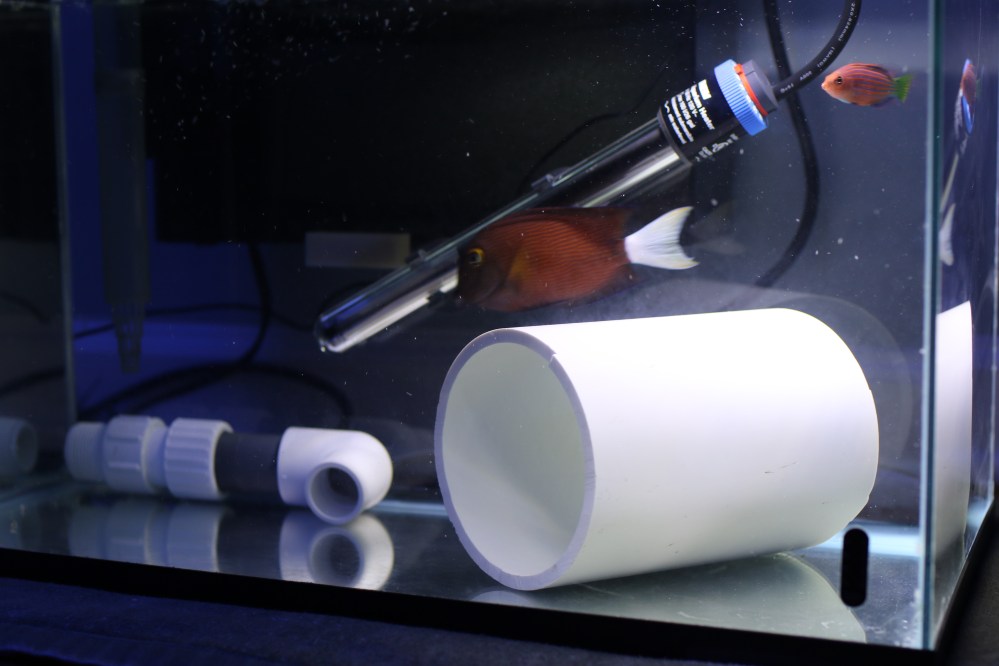
The quarantine tank is a ten gallon glass aquarium that was actually my first ever and dates back to the late 80s. It is the definition of nothing fancy, but it works perfectly. I do have a decent filter on the quarantine tank — I use an Aquaclear 110, which is probably overkill, but it seems to work well and it is old equipment that I don’t have another use for. I use the corresponding foam block for mechanical filtration. Since I keep my fish in quarantine for a minimum of 4 weeks, I prefer to have a biologically established quarantine system. To accomplish this, I set the tank up at least a week before I go fish shopping and I keep a seeded a mesh bag of zeolite in my sump that I transfer over to the Aquaclear filter a few days before adding any fish. I have no idea if anyone would consider this a good idea, but it has worked well for me. Once the quarantine tank is broken down, I discard the zeolite and bleach the mesh bag for the next time.
I’ll quarantine 1 to 3 fish at time — depending on what I find at the local fish store. I typically give the new fish a couple of days to settle in before I start even thinking about medicating. I will try some food during the first day of quarantine, just so I can get a baseline of how much effort it is going to take to get the new fish fully healthy and ready for the main tank. If the new fish settle in nicely and starting eating fairly quickly, I’ll typically just monitor very closely the first 4 days for any signs of illness. If anything shows up, I’ll diagnose and treat accordingly. If no signs of disease appear, most of time, I will simply monitor the fish the remainder of their time in quarantine and only treat if something shows up. Occasionally, I have preemptively treated with Cupramine. Using copper in quarantine is a post in itself, so I won’t go into all of the details here. Basically, sometimes even if a fish is largely asymptomatic, there are still some minor signs of possible problems that I feel exceed my comfortable risk zone of not treating. I’ve never had an issue treating with Cupramine; therefore, I don’t have much issue with a preemptive dosing schedule.
Maintenance
Because of the quarantine duration, I do feel it is necessary to clean the tank at regular intervals. When I do a water change from the main tank, I use the old main tank water to refill the water I siphon out of the quarantine tank. I also thoroughly rinse out the Aquaclear foam block weekly and use activated carbon to remove any meds that I have added.
It should go without saying, but I am very careful to clean anything I use in the quarantine tank that I also might need to use in the main tank. Some people advise keeping everything 100 percent separate with duplicates of any item you need for quarantine so that it never needs to be used or co-mingled with main tank equipment. This seems like overkill to me — bleach takes care of a lot and so does hot freshwater for that matter. I am not aware of ever having introduced something to the main tank by using a net that I have used on both, but have cleaned carefully between uses.
Transfer to the Main Tank
Once a fish in quarantine has been symptom free for 4 to 6 weeks, I move them to the main tank. First I net the fish, then put it into a small bucket of main tank water, then pour the fish and bucket contents into a clear acrylic acclimation box in the main tank just to make sure none of the inhabitants don’t go into full on attack mode right away. Finally, I’ll release the new fish into the general population along with some food to distract the rest of the inhabitants. This seems to give the new fish a running start before some of the more aggressive tank makes get bored and cranky. Thankfully, this method has served me particularly well and I have not yet had to remove anyone for excessive bullying.
Finally, unless I am heading back the fish store for more livestock, I break down the quarantine tank and store it for later use.

 Age of Aquarist